Ad4

Saturday, 1 August 2015

Facts about John Nash

1. Nash was an introverted individualist as a child
Long before John Nash exhibited any interest in mathematics, he already had certain unique features that, one might argue, predicted his success in later life. His sister Martha remembered her brother being a unique and introverted child:
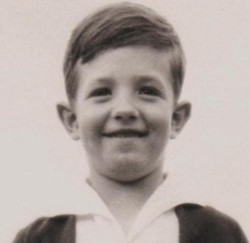
Johnny was always different. [My parents] knew he was different. And they knew he was bright. He always wanted to do things his way. Mother insisted I do things for him, that I include him in my friendships. … but I wasn’t too keen on showing off my somewhat odd brother.
2. One of Nash’s inspirations — E.T. Bell’s Men of Mathematics
When Nash was 14 years old he showed first signs of passion for mathematics. One of the biggest inspirations was E.T. Bell’s classic book titled The Men of Mathematics, which tells the story of some of the greatest mathematicians throughout history. The book is also famous for inspiring another great future mathematician — Freeman Dyson.
3. Nash’s first passion was chemistry 
Before finding one’s way as a mathematician, Nash had a profound interest in chemistry. In 1941 he entered Bluefield College, where he enjoyed studying science subjects, especially chemistry. This passion interestingly lead to another eccentric hobby — practical jokes.
4. Nash was a renowned prankster
John Nash’s way of letting his steam off was pranking other people. It appears that the aspiring mathematician had a special talent for coming up with unique ways of tricking people. He is famous for using his chemistry knowledge to make explosives or tying his sister to a chair wired with batteries.
5. Nash used to have long discussions with Einstein
While studying in Princeton, Nash had many opportunities to meet renowned aspiring mathematicians and physicists. There he also became interested in tensors and general relativity. He even had a chance to meet Albert Einstein himself and to discuss his ideas regarding gravity.
6. Nash met his future wife Alicia in an advanced calculus for engineers class
Alicia, besides being  renowned for her talents in mathematics, was a cosmopolitan coming from an aristocratic family, which spoke French and English as well as Spanish, often traveled abroad and valued intellectual prowess as well as art. Nash found these features very appealing and later wrote: She was one of the few girls that attracted my attention.
7. Nash was a bit of a legend in Princeton
Despite his mental problems Nash was allowed to come back to work in Princeton, where he became a bit of a local legend. He would wander around the campus with his red sneakers, write mysterious equations on blackboards and was liked by many students.
8. Nash credits logical thinking for his recovery
John Nash quit taking anti-psychotic medication in the early 1970s. Despite this, however, he was able to make an impressive recovery, especially in the early 90s, when he received the Nobel prize in economic sciences. Nash himself often said that his recovery was due to the ever-going struggle between his logical mind and delusional thinking in which clear thinking came on top.
9. Even at an old age Nash preserved his intellectual abilities and curiosity 
Despite long years of mental illness, Nash always expressed his wish to come back to mathematical research. Among his beloved topics of game theory and economics, he also expressed great interest in cosmology and gravitation.
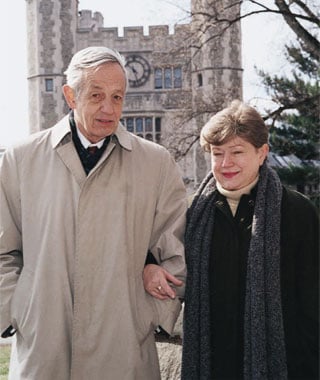
                                        
10. John and Alicia remarried in 2001
Despite many ups and downs in their relationship and Nash’s mental health, John and Alicia always stayed close. Due to relationship problems they got divorced in 1963, but later in the early 70s Nash lived in Alicia’s house as a boarder, where she took great care of him. According to Nash, his wife’s care and love was another major factor in his recent recovery.
Source: physicsdatabase.com

Everything you need to know about Alan Turing

An English mathematician, logician and cryptographer, Alan Turing was responsible for breaking the Nazi Enigma code during World War II. His work gave the Allies the edge they needed to win the war in Europe, and led to the creation of the computer. On the PBS NewsHour tonight, Jeffrey Brown interviews Benedict Cumberbatch about his role as Turing in “The Imitation Game.”
Turing took his own life in 1954, two years after being outed as gay. Homosexuality was still a crime in Great Britain at the time, and Turing was convicted of “indecency.” He died from eating an apple laced with cyanide. He was only 41 years old.
At the time of his death, the public had no idea what he had contributed to the war effort. Sixty years later, Queen Elizabeth II officially pardoned Turing.
Andrew Hodges, a mathematician at the Mathematical Institute at Oxford University, wrote the biography “Alan Turing: The Enigma”, which inspired the film. We spoke with Hodges this week about some things many people don’t know about Turing.
Photo by Fine Art Images/Heritage Images/Getty Images

1. He was an Olympic-level runner

He participated in a few sports, such as rowing, but he loved running. Turing had “a bit of a ‘smelly trainers’ aspect” to his personality,” Hodges said. To work it into his day, he often ran to the places he needed to go. He used to run the 10 miles between the two places where he did most of his work, the National Physical Laboratory and the electronics building on Dollis Hill, beating colleagues who took public transportation to the office.
He joined running clubs, becoming a competitive amateur and winning several races. In 1948, his best marathon time was 2 hours 46 minutes 3 seconds — only 11 minutes slower than the Olympic winning time that year.
When one of his running club members asked why he trained so vehemently, he replied, “I have such a stressful job that the only way I can get it out of my mind is by running hard.”

2. He embodied some values of the Hippie movement

“He was a hippie before his time,” Hodges said. “He was very casual in those days, and thought very scruffy.” Had he lived a few decades later, he would have worn t-shirts and jeans every day, Hodges added.
It wasn’t uncommon to see Turing dressed rather shabbily, with bitten nails and without a tie, he said. With his youthful face, he was often mistaken for an undergraduate even in his 30s.
He also shared the left-leaning views of many of his Kings College compatriots, who included economists John Maynard Keynes and Arthur Cecil Pigou. Though Turing joined the Anti-War Movement in 1933, he never got deeply involved in politics. But watching Hitler’s rise to power in the late 1930s scared him, Hodges said, and it spurred his interest in cryptography, which would later help Great Britain in the war.

3. He got bad grades and frustrated his teachers

Science was a considered a second-class pursuit in English public schools in the 1920s, Hodges said. Turing’s passion for science embarrassed his mother, who had hoped he would study the classics, which was the most acceptable pursuit for gentlemen.
But he got bad to mediocre grades in school, followed by many complaints from his teachers. His English teacher wrote:
“I can forgive his writing, though it is the worst I have ever seen, and I try to view tolerantly his unswerving inexactitude and slipshod, dirty, work, inconsistent though such inexactitude is in a utilitarian; but I cannot forgive the stupidity of his attitude towards sane discussion on the New Testament.”
His math and science grades weren’t much better. He was nearly stopped from taking the national School Certificate exams on the subject, for fear he would fail.

4. The father of the computer also dabbled in physics, biology, chemistry and neurology

Turing’s most notable work today is as a computer scientist. In 1936, he developed the idea for the Universal Turing Machine, the basis for the first computer. And he developed a test for artificial intelligence in 1950, which is still used today.
But he also studied physics, especially as a young man. He read Einstein’s theory of relativity as a teenager, and immediately filled a notebook with his own thoughts and ideas on the subject. He dabbled in quantum mechanics, a new field at the time, as well as biology, chemistry and neurology after the war. Much of this work was related to creating machines that could learn and “think”, but some of it came out of simple curiosity about the world.

5. He developed a new field of biology out of his fascination with daisies

Even as a child, Turing saw life through the eyes of a scientist, Hodges said. There is a famous sketch of Turing as a boy “watching the daisies grow” while the other children play field hockey. That sketch would foreshadow Turing’s ground-breaking work in 1952 on morphogenesis, which became a completely new field of mathematical biology. It was a mathematical explanation of how things grow — a great mystery to science, Hodges explained. His work on the subject has been cited more than 8,000 times.
The subject of one of his seminal papers on the topic was called “Outline of the Development of the Daisy."

6. He stuttered when talking

It is true that he had a bit of a stammer, something dramatic portrayals of Turing have exaggerated, Hodges said. He “took his time finding the right words,” he explained. In his biography he notes that a BBC radio producer had called Turing a very difficult person to interview for that reason.

7. He didn’t keep his sexuality a secret among friends

The laws at the time prevented Turing from being openly gay, but he never kept his sexuality secret either. He was open with his social circles at Kings College in Cambridge, which was “an oasis of acceptance” at the time, Hodges said. Many people would have clung to that oasis, he said, but Turing branched out to continue his work.
In 1952, he was arrested and charged with “indecency” after a brief relationship with another man. Defiant, he did not deny the charges.
“When he was arrested, the first thing he said was he thought that this shouldn’t be against the law,” Hodges said. “He gave a statement that was unapologetic, that detailed what had happened.”

8. He refused to let a punishment of chemical castration stop him from working

The punishment for homosexuality was chemical castration, a series of hormone injections that left Turing impotent. It also caused gynecomastia, giving him breasts. But Turing refused to let the treatment sway him from his work, keeping up his lively spirit.
“He dealt with it with as much humor and defiance as you could muster,” Hodges said. “To his close friends, it was obvious it was traumatic. But in no way did he just succumb and decline. He really fought back … by insisting on continuing work as if nothing had happened.”
He openly talked about the trial, even in the “macho environment” of the computer lab. He mocked the law’s absurdity. In defiance, he traveled abroad to Norway and the Mediterranean, where the gay rights movements were budding.
Homosexuality was considered a security risk at the time, and the conviction cost Turing his security clearance. That was a harsh blow, and Hodges believes that when he was restricted from leaving the country anymore, it ultimately led Turing to suicide.
“After he’d been revealed as gay in 1952, he couldn’t do any more secret work,” Hodges said. “It would have been hard to accept that he was not trusted.”

Source; pbs.org

Wednesday, 29 July 2015

Everything you need to know about MARCOS

1.MARCOS were raised as the Indian Marine Special Forces (IMSF) in 1985. Two years later, they were renamed the Marine Commando Force (MCF). Their motto is – The Few The Fearless.
2. Becoming a MARCO or a Marine Commando is no cakewalk. Trainees have to undergo one of the world’s toughest courses that can last between two-and-a-half to three years, depending on the specialisation.

                              MARCOS
Reuters
3. Getting selected to be trained as a MARCO itself is difficult. The pre-training procedure, which includes a three-day physical fitness and aptitude test, sees almost 80% applicants being screened out. And it gets worse. A five-week-long ‘hell’s week’ follows this, which includes sleep deprivation and intense physical training. Those that make it through, or don’t quit on their own, actually proceed to the actual training.
4. Those that clear the selection then start undergoing the grilling course which includes basic training at INS Abhimanyu in Mumbai. The trainees then train in para jumps at the Paratrooper Training School in Agra and a diving course at Navy’s Diving School in Kochi.
                           
                               MARCOS

5. After this basic training, they join – on probation – their respective groups for advance training. This includes training for counter insurgency, anti-hijacking, anti-piracy, clandestine operations, surveillance and reconnaissance, amphibious operations, unconventional warfare, and hostage rescue, among others.
6. All MARCOS are static line para jump qualified and some are qualified for freefall (HALO/HAHO) para jumps – High Altitude Low Opening and High Altitude High Opening. In fact, MARCOS are the handful of the special forces from around the world that are capable of being para dropped into the sea with the full combat load.

                                        MARCOS

7. MARCOS are also trained in High Altitude Commando Course at the Parvat Ghatak School in Tawang, Arunachal Pradesh, at the Desert Warfare School in Rajasthan, High Altitude Warfare School (HAWS) in Sonmarg and Counter Insurgency and Jungle Warfare School (CIJWS) in Mizoram.
8. Their training makes MARCOS tough nuts to crack. An Indian MARCO on an exchange program in the US topped the US Navy SEAL course with ease.

                                      MARCOS

9. After completion of training, a MARCO serves with the elite outfit for 3 to 5 years.
10. The MARCOS are equipped with some of the best weapons in the world. The units are equipped with the Israeli Tavor TAR-21 assault rifle to which a 40 mm grenade launcher can be attached. The TAR-21 is weather sealed, so a MARCO can emerge out of the sea, weapon drawn and ready to shoot. A scary sight for the bad guys!

                                  MARCOS

11. Other weapons include the Heckler & Koch MP5 sub machine gun for close quarter battles, the SIG Sauer P226 and Glock 17 pistols and the Druganov and Galil sniper rifles and OSV-96 semi-auto heavy caliber anti material rifle. Apart from the weapons, they also operate two man subs, the Italian CE-2F/X100, for conducting covert underwater operations.
12. The MARCOS operations are the stuff of legends. Op Pawan in Sri Lanka, an operation to blow up the Jaffna jetty, saw MARCOS swim 12 kms to their target with their combat load in tow. They then slipped in without being detected and blew up the harbour with explosives. They were immediately fired upon by the LTTE. The commandos returned fire and managed to swim back to the ship without any casualties.

                                    MARCOS

13. In 1988, the MARCOS, as a part of Op Cactus, thwarted an attempted coup in Maldives. They captured the boat with 46 mercenaries and their hostages that had escaped after the failed coup attempt.
14. During the Kargil War, the MARCOS were tasked to undertake covert operations behind enemy lines. During the Mumbai attacks in 2008, they stormed the Oberoi Trident and Taj hotels where the terrorists were killed.

                                 MARCOS

15. Even the terrorists in Kashmir are scared of the MARCOS and refer to them as ‘Dadiwala Fauj’, thanks to the beards they wear as disguise.
Source: India Times